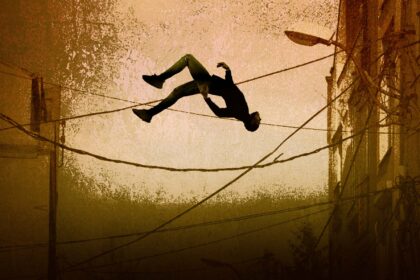



In the video, a policeman chases two black men fleeing across a red roof. He wants to corner them, but one of them outruns him with a feint and runs away. The other, a thin figure wearing a reflective vest like those worn by construction workers, is trapped. The officer catches him and grabs him by his clothes. The man tries to break free, but the policeman drags him to the edge of the roof.
And throws him off.

«Baba, Baba (My God, my God), they killed him!» exclaims the woman recording the video on her mobile phone in Creole, the Haitian language. The man in the reflective vest disappears from view. The woman is left sobbing.
I received the video on the afternoon of October 4, two days before landing in Santo Domingo, the capital of the Dominican Republic. The source who sent it to me knows nothing about the three protagonists, nor about the woman who is wailing. Nor does he know where it was filmed. The low, tin-roofed houses resemble those in any of the neighbourhoods where, according to human rights NGOs, the Dominican authorities detain hundreds of young people, children and women – with and without their babies – locking them in rolling cages before deporting them to Haiti.
What my contact is convinced of is that the scene took place between the last days of September and the first days of October 2024. The government of Luis Abinader has promised to remove 10,000 Haitians from the country each week, and the migration police, the national police, the armed forces and part of the Dominican population, some of whom are arming themselves, are working together to fulfil that promise and «defend» themselves against what the official narrative has called an «invasion.» During the month I will be reporting, the government will deport nearly 28,000 Haitians. My contact also believes that the man in the vest is dead. That would be normal after a fall like that.
For me, this video represents the essence of this violent logic that seems to have possessed the Dominican Republic against its neighbours: two black men fleeing across a rooftop, a uniformed man chasing them, a man thrown like a bag of rubbish, a woman crying.
Similar videos showing police brutality against black people sparked outrage and collective mobilisation in countries such as the US. The Black Lives Matter movement, which led to the largest civil protests in the US in 60 years, was born after a video showed police killing George Floyd while he cried out, «I can’t breathe.»
The largest civil unrest in California in the 20th century erupted after a mostly white jury acquitted white police officers for the beating of African American Rodney King in Los Angeles, even though they were immortalised in a video recorded by a neighbour shouting things similar to what I hear in the video I now have in my possession.
That is why, upon arriving in Santo Domingo, I am accompanied by what will become an obsession: to find the man in the video, or his grave, or someone who misses him; to be able to answer what forces are at work that prevent trials, investigations, protests and fire.
A police officer throws a man off a roof somewhere in the Dominican Republic amid the government’s policy of mass deportations of Haitians.
***
I have an appointment at MOSCTHA, an NGO supporting the Haitian population, but when I arrive at the premises, a group of ultra-nationalists in dark clothes calling themselves Código Patria have blocked the entrance. They are not allowing anyone to enter or leave. There are about 50 people with Dominican Republic flags and portraits of Juan Pablo Duarte, the hero who led the war of independence from Haiti in 1844. They have placed a loudspeaker in front of the entrance to the institution and are shouting anti-Haitian slogans.
«We don’t want Haitians here, send them back to Haiti!»
The institution functions as a clinic for Haitian migrants with and without papers. It has a radio booth where it broadcasts in Creole to the country’s Haitian community, and a special programme to care for people with HIV.
«If they don’t leave, we’ll get them out. The Dominican Republic is for Dominicans!» shouts Wendy Santiago, the founding leader of Código Patria.
After about two hours, the slogans and insults stop, they put away their loudspeakers and flags and leave. The clinic reopens and the patients reappear, as if they had been hiding nearby.
In front of the clinic, I am greeted by Joseph Cherubin, the director of the institution. I am here because he is going to give me access to a network of Haitian leaders in the Dominican Republic. These are union representatives, evangelical pastors, and Ungans, Mambos, and Bokos, as the priests and priestesses of the Voodoo religion are known, who have established a rudimentary and quasi-clandestine system of support for the migrant community.
It is this network that organises collections to cover the medical expenses of sick or injured Haitians, provides shelter and protection when immigration raids intensify, and documents the constant harassment by the authorities and ultra-nationalist groups. It is this network, with few resources and limited international connections, that stands between many Haitian migrants and death or other horrors.
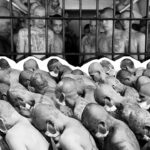
A mother holds her son outside the bars of one of the rolling cages where Haitians are transported in the Dominican Republic before being deported.
Networks of this kind have accompanied the African American community almost since the time of the great kidnappings in Africa and the years of colonialism and slavery. In the 19th century, Harriet Tubman, a black woman enslaved in the southern US, led an underground network that fought for the abolition of slavery and supported the escape of slaves from the South to the abolitionist states of the North. This network was known as the «Underground Railroad,» and it is estimated that at least 100,000 slaves used it to gain their freedom.
In 2017, writer Colson Whitehead won the Pulitzer Prize for his novel The Underground Railroad, based on this historical episode, and in 2023, director Barry Jenkins adapted it into a series for HBO.
In the Dominican Republic, a similar railway, created by black men and women, operates today. Like its predecessor, it must operate in the shadows if it is to survive. Unlike its predecessor, however, it does not seek to free people from slavery and give them their freedom, but rather to ensure that people are treated as humans and remain where they are.
Cherubin takes me to his office and explains that there are raids to hunt down Haitians in the mornings and afternoons. He tells me that the police seem to have daily quotas and that if they don’t meet them, they go into the neighbourhoods at night to kidnap people. He takes out his phone and opens folders containing videos and photographs sent to him over the last month by Haitian leaders across the country. The file seems endless. It’s like a huge menu of horrors.
He shows me dozens of videos of black people running from their uniformed pursuers, often black themselves. In one, a woman is screaming that her newborn baby will starve to death if she does not return, while they insult her and drag her towards one of the cage trucks that the government has set aside for deportation. Another woman presses her baby against the bars of one of the trucks so that it does not fall onto the street while the truck is moving. Then there is a video showing three uniformed men beating a black man on the head with a club.
«Stand up, you fucking Haitian devil!» they shout as the man convulses on the ground, bleeding.
He shows me videos that have been recorded by people detained and in the custody of the Dominican government: Haitians fainting, crammed like cattle into large unventilated warehouses; people shouting in Creole that they have not been able to speak to their families or have access to lawyers for eight days; people defecating in bags inside rolling cages after 12 hours of confinement under the sun.
Many of these Haitians are in a huge detention centre located in the town of Haina, the same place that for decades served as a destination for Dominican holidaymakers and which, although it sounds like a bad joke, still retains its old name: Haina Holiday Resort.
Among these videos, I cannot find the one of the man who was thrown off a roof by the police. I tell Cherubin I want to find him. He tells me that the network will get to work and that he will find him for me. Him or his grave.
The Haitian «underground railway» assigns Moisés, a man in his forties, as my guide. He is bald, solidly built and has a perfect smile. He is an old Caribbean fox who knows how to move around the Haitian neighbourhoods in the midst of a police hunt.
Two days after my visit to the NGO, Moses calls me on the phone, «He’s alive.»
***
The woman in charge of the door at the trauma hospital in Santo Domingo lets only me in. She shoos Moisés away, like a child, or rather like a fly. On the third floor, in room 204, on a stretcher, bandaged from the waist up and a pale, pale grey, is Keken, a 22-year-old Haitian. His brother is with him, but neither of them speaks Spanish. They have to resort to sign language to tell me their story. They call one of the leaders, an evangelical pastor, and he translates for me over the phone.

Keken, a 22-year-old Haitian man, is in a hospital in the Dominican Republic. His body is bandaged after falling off a roof while being chased by a police officer.
On the morning of October 1, 2024, Keken was on his way to work at a cement block factory when the police chased him amidst one of the new immigration raids. He climbed to the third floor, but the police ran after him and cornered him. Keken fell to the ground and was left unconscious with a broken hip and several broken ribs, as well as numerous fractures and bruises. The police left him bleeding in the dust on the street.
The Haitian underground railway has been taking care of him since then and they have managed to get him a place in the hospital. But in order to operate on him, they are asking for several bags of blood and medication worth about 300 US dollars, which the network has not yet been able to obtain.
A group of doctors enters the room, where other badly injured men are also lying, and ask Keken questions, but he only raises his eyes to his brother, who in turn glances at me.
I tell the doctor that I am a journalist and that I am writing about this case and others.
«We treat all kinds of people here, it doesn’t matter if they are Haitian. We have to treat them the same,» he says automatically.
I explain that they don’t speak Spanish but that they can use the same pastor as an interpreter. He refuses. I ask him how they communicate with Haitians who don’t speak any Spanish.
«We have a colleague who speaks Creole, but there are no interpreters here. Sometimes they understand something or there is someone here who can translate,» he tells me.
If there is no one, as in Keken’s case, then nothing is done, and they turn around and leave without informing the patient about their condition. I ask him if there are many foreigners in similar conditions.
«Yes, there are several Chinese, but they are more responsible than the Haitians,» he tells me and continues on his way.
Keken arrived in the Dominican Republic just a year ago. He was born near Cap-Haïtien and came here looking for work and fleeing the violent chaos of gangs and famine. It is not certain that he will ever walk again. If he does, it will certainly not be as he did before.
Keken is not the man on the roof I am looking for; it is another man on another roof.
***
«We’ll keep looking,» Moisés promised me the day we visited Keken in the hospital. I’ve been in Santo Domingo for a week when he calls me again.
«A leader has found him in Villa Mela,» he tells me, referring to a neighbourhood with a large concentration of Haitians. He tells me that the network has spread the word that there is a journalist writing about cases of abuse against Haitians and dozens of leaders, pastors, Bokos, and activists from all over the country are writing, sending videos, photos and statements. A Haitian evangelical pastor has written to the underground railway and says he knows where to find the man on the roof. He says that it seems to have happened on the territory of a leader named Vania.
We travel together with this pastor, whose name and details it would be prudent not to reveal, to a densely populated neighbourhood an hour away from Santo Domingo.
Vania welcomes me into her office. She is a plump woman with hair down to her chin. She has a kind face and a contagious smile. Like Cherubin, she runs an NGO supporting the Haitian migrant community. Hers is called the Socio-Cultural Movement for Community Development. She tells me about the crisis in her sector, about thousands of displaced Haitians, about children who are left alone when their mothers are taken away. Like Cherubín, she has her own archive of terrifying videos.
The few NGOs defending Haitians in the Dominican Republic receive dozens of videos from across the country showing human rights violations suffered by this community.
Vania says that the offensive against the Haitian community is getting worse over time, that it seems to be cyclical. History seems to prove her right.
In the 1930s, dictator Leónidas Trujillo banned many expressions of Haitian culture in the country and organised one of the most brutal massacres in Latin America in 1937, with the murder of between 5,000 and 15,000 Haitians in the border region of Dajabón. The tyrant was assassinated in 1971, but he left behind the seeds of ethnocide that are blossoming once again.
In 2013, a constitutional reform stipulated that all children and descendants of «illegal» Haitians, despite being born in the Dominican Republic and having birth certificates and identity cards, automatically cease to be Dominican, with the loss of rights that this entails.
According to Haitian organisations—the lack of official statistics does not allow for a more precise figure—between 500,000 and more than one million Haitians currently live in a country with a population of just over 11 million.
More than 200,000 people are condemned to statelessness; they are not Dominican, but they are not Haitian either, since they were not born there. They are condemned to float in the uncertainty of being illegal wherever they are.
The Community of Organised Haitians, a group of pro-migrant institutions, has documented hundreds of cases in 2024 of children, pregnant and breastfeeding women caged in appalling conditions and deported, and people imprisoned in rolling cages without the minimum conditions required by international treaties. Over the past five years, this group of NGOs has sent an annual report documenting these abuses to the Attorney General’s Office, without any investigation being launched.
Hate speech has also taken root in society. Dozens of anti-Haitian groups threaten, kidnap and attack Haitian leaders and organisations with total impunity.
These are not isolated cases. These are not rogue police officers. These are not groups of lunatics who hate their neighbours. Since 2021, when the Haitian exodus began to increase as their country collapsed, the Dominican Republic has deported 400,000 Haitians, according to the International Organisation for Migration. What is happening on this Caribbean island is a system of racial segregation. It is apartheid.
Vania shows me one of the most effective measures for protecting migrants. It is a video that her network has produced for the Haitian community. In it, a young woman explains what they should do if they are pursued by the police. She tells them to stay calm, try not to walk alone, teaches them a few words in Spanish and emphasises that they must not fight or run.
When I ask her about the boy on the roof, Vania says he is barely alive in one of the neighbourhoods of Villa Mela.
***
The following afternoon, Moisés guides me to Villa Mela. Haitian workers are leaving the construction sites and filling the slums. A police patrol has been following us since we arrived in the area.
«Stay calm, they won’t do anything to a journalist. They want to take our money, but they won’t do anything,» Moisés tells me in broken Spanish and with a disturbing calm.
Before we reach the entrance to the neighbourhood, the patrol car cuts us off. Two uniformed men surround the car like cowboys, their hands on their guns.
A policeman who identifies himself as Officer Reyes takes my papers and writes down my details in a notebook. He doesn’t even ask for the vehicle documents.
«Haitian, do you have your papers, are you in order?» the policeman snaps at Moisés, who hands them over silently, without taking his defiant gaze off the officer.
They rummage through my things and destroy a box of granola bars that I had kept in the back seat of my truck in an attempt to be healthier. They ask us where we are going. I don’t answer. They leave, but follow us for several blocks until we make a few turns and head into the hills.
We climb up into the neighbourhood along muddy streets, dodging the huge puddles left behind by last night’s rain. Most of the houses are small, with tin roofs and small wooden cubes resembling barracks.
After a long drive, we arrive at a small house. Inside, face down on a small wooden cot, is Daniel, moaning in pain. His sound is a soft, long groan, like someone who has been hit in the stomach. Talking hurts; moaning seems to hurt him too. He has about six bullet holes in his lower left back.
Daniel was shot in the back by a police officer during a deportation operation.
A few days ago, two police officers tried to arrest him while he was on his way to work at a construction site. Daniel did not stop and tried to escape. Then one of the officers shot him in the back. The shot was fired at close range, and the pellets from the shotgun had not yet expanded much, only a few centimetres. The shots didn’t go through Daniel. They knocked him down.
According to his family, the police forced him to walk on his knees for a while and tried to take him away. But when they saw that he was bleeding heavily and that the neighbourhood was starting to get rowdy and groups of young men were gathering on the corners in outrage, they left him lying in the dust.
Before I leave, Moisés tells me that he will take my car. He insists that the police officers who stopped us are the same ones who shot Daniel and believes that they could arrest us or screw us over in some way. The vast Haitian railway network needs to get these stories out of the neighbourhood and they don’t want to risk my photos, recordings and videos ending up in the hands of the police. They put me on a motorbike and take me away through other alleys.
***
After my failures, I believe that I will not find that man on the roof or his remains, that this case will be forgotten, that his life, or his death, will only pass into posterity as an anonymous video where an anonymous police officer throws a nameless man who had come from a dying country to work and who that day was wearing a reflective yellow vest and blue trousers into the void. But the underground railway is making itself felt again.
Rony, one of the most active leaders, whose name is of course not Rony, tells me that the leaders have sent him the same video. He tells me that the boy is alive and under the protection of Pastor Wilson, whom he names as if I should know who that man is.
After a dramatic silence, he tells me that he is a Haitian leader operating on the other side of the country, in Punta Cana, the tourist gem of the Dominican Republic. That pastor is being persecuted by the Dominican authorities for his constant denunciations and for keeping an extremely detailed record of the abuses, murders and mistreatment of the Haitian population by the authorities. He has been threatened several times, which has made him wary. It is very difficult to talk to him on the phone. Other Haitian leaders who tell me about him describe him as a tough man who, in addition to being a community leader and pastor, is a private detective. They say he watches his back very closely.
If I want to find the man on the roof, Rony assures me, I will have to go to Punta Cana, 200 kilometres from Santo Domingo, and speak to Pastor Wilson in person.
After walking blindly in search of a ghost, the information that arrives via the underground railway breaks the anonymity of the man on the roof: Mikelson, the man on the roof is called Mikelson.
To be continued…

*This investigation is a production of Regional Editorial and Dromómanos and was originally published in December 2024 thanks to the support of the Consortium for Supporting Regional Journalism in Latin America (CAPIR), led by the Institute for War and Peace Reporting (IWPR).